


Mission - Goals - Tasks
Aater Wise Societies mission, Sustainable water for all by 2050, is broken down into three goals that are concretized in 10 tasks. The missions will mobilize actors to make the transition from the present to the desired future. By solving the tasks, we can reach the goals and contribute to the mission.
Resilient supply and management of water in society
– where communities are built and managed in harmony with water, offer a good quality of life and are resilient to climate change, crises and war.
The goal can be achieved by solving the following four tasks:
– Secure water supply and management
– Ensure good drinking water quality
– Adapt society to floods and droughts
– Build and manage society in harmony with water
Wise use of water
– where all parts of society use only the quantity and quality of water they need. Water and its resources are circulated in a safe and sustainable way.
The goal can be achieved by fulfilling the following three tasks:
– Ensure sustainable water withdrawals
– Reduce water use and leakage
– Recycle and reuse water and its resources

Thriving and healthy waters
– protected and future-proofed, where risks and sources of pollution are identified and minimized.
The goal can be achieved by fulfilling the following three tasks:
– Reducing negative impacts on aquatic ecosystems
– Prevent and reduce the spread of dangerous substances
– Reducing eutrophication in lakes and rivers
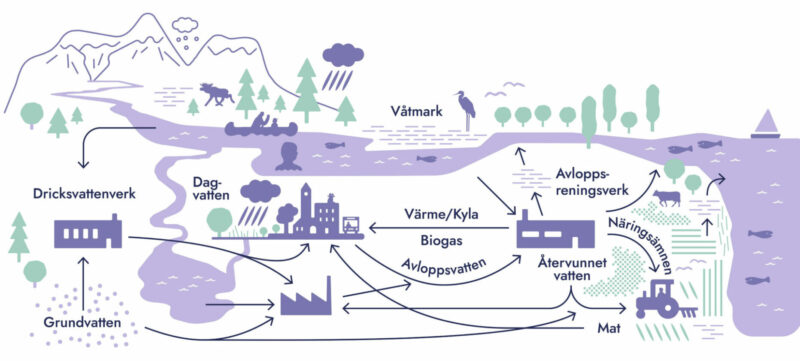
From source to coast
System dimensions
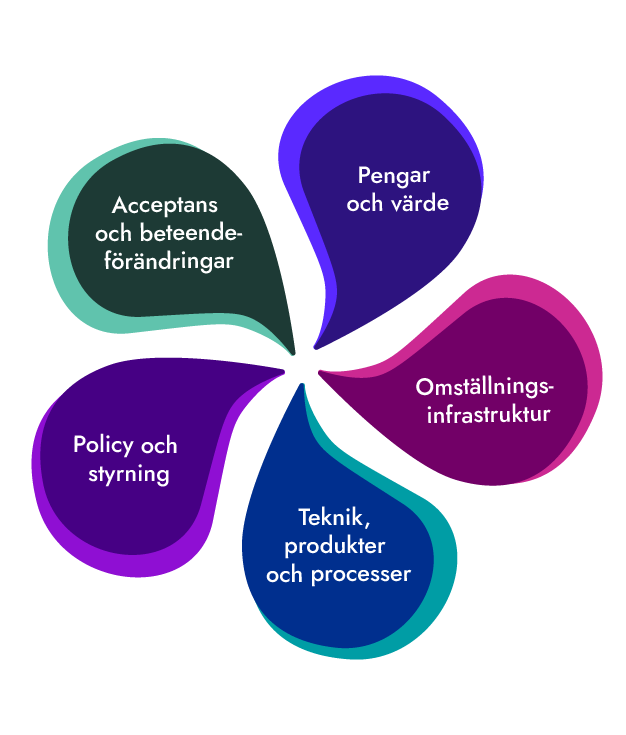
Within Water Wise Societies we have defined five system dimensions where the right conditions need to be in place for the transition to be possible.
- Acceptance and behavior change: Change of things that lead to a different behavior or new ways of acting and thinking. This may involve accepting necessary new solutions and changing behaviors that support the transition.
- Money and value: Change in things that can be considered to provide value, such as funding, business models, utility models, value networks and budgets.
- Transition infrastructure: Changing the space and conditions for actors to act and adapt. Examples include processes and platforms for collaboration, skills, capacity building and digitalization, and strategic organization and management.
- Technologies, products and processes: Changes to equipment required for the transition. For example, new technologies, infrastructure, data and digital systems.
- Policy and governance: Changes to things that govern and set frameworks, such as laws, regulations, frameworks, standards, guidance, roadmaps and strategies.